Sunday, December 12, 2010

The Christmas Photo Card

via The Telegraph

 Among others, The Telegraph has been poking Charles and Camilla a bit ever since the couple's holiday photo was revealed. This, I confess, is an entirely alien joke to the American. We have come to accept the "jolly stressful [rush]...to find a suitable picture each year." Few "make do with robins or holly or baby Jesus" anymore. After all, what good would a Christmas greeting be if it didn't include a little photographic reminder of who is sending the d-mned card in the first place? Oh, so that's Chuck's new wife...interesting choice.

Saturday, December 11, 2010

Edward VIII

Edward as Prince of Wales, in Ontario, 1919
On December 11, 1936, Edward VIII publicly abdicated the throne of England and turned from his role as King of United Kingdom and its dominions and Emperor of India for love of the American divorcee Wallis Simpson.


The romantic relationship succeeded in capturing the imagination of America as it struggled to survive the Great Depression. So much so, in fact, that in 1936, America's weekly news magazine, TIME, chose Wallis Simpson to be the first female awarded TIME's "Person of the Year."  Edward VIII's relationship with Wallis defied both the wishes of his family and the British government. It soon became clear that Edward could have Wallis or the throne; but he could not have both. Presented with this choice, Edward, under what many felt to be the bewitchment of Wallis' stronger personality, opted for love and left the throne to his younger and quite unprepared brother, George VI (or "Bertie").

The Duke and Duchess of Windsor continued to make waves internationally in the days following their marriage in June of 1937. Relations between the Duchess and the royal family did not improve. Indeed, one could argue that they worsened. The royal family refused to allow the Duchess to assume a royal style.

Living in France, the Duke and Duchess made little effort to avoid accusations of pro-Nazi sympathies. The Duke gave dubious public statements, which left his sympathies up for interpretation. The Duchess was chummy with Diana Mitford, a well-known Nazi sympathizer. With the outbreak of war, PM Winston Churchill threatened the Duke with court-martial in order to persuade him to accept the wartime governorship of the Bahamas, a British colony.

Although the Duke succeeded in doing some good during his governorship, it is difficult to view the Windsors' time in the Bahamas without some distaste. The Duke and Duchess' prejudices were too often vocalized, and the governorship of the Bahamas often showcased the Duke and Duchess' racism. Nevertheless, the British government did succeed in limiting the Duke's damage to the British war effort by preventing him the means or opportunity to act on any pro-fascist sympathies. In his memoir, the Duke defended himself, emphasizing that his admiration for the Germans stopped short of sympathy for fascism.
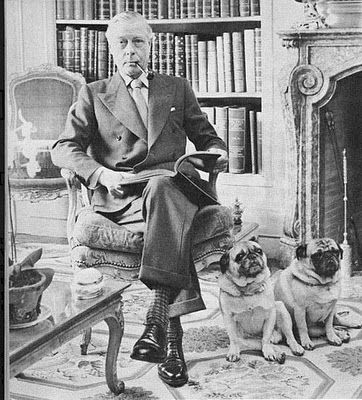
The Duke in his library as pictured in The Windsor Style by Suzy Menkes
When the war ended, the Duke and Duchess returned to France where they lived a retiring life as celebrities. Their social calendar typified that of cafe society--they entertained in their gorgeous houses and the Duke published small works. To this day, the Windsor's personal sense of style is widely, and rightly, celebrated.
The Duke & Duchess of Windsor, 1964, via The Windsor Style 

The Duke of Windsor via The Windsor Style

Monday, December 6, 2010

A tinkling piano in the next apartment... ♫

Bryan Ferry's airy, eclectic city digs

via WSJ

These foolish things remind me of you.
A tinkling piano in the next apartment
Those stumblin’ words that told you what my heart meant
A fairground’s painted swings
These foolish things
Remind me of you.
You came,
You saw,
You conquered me
When you did that to me
I knew somehow this had to be
The winds of march that made my heart a dancer
A telephone that rings but who’s to answer
Oh, how the ghost of you clings
These foolish things
Remind me of you

(excerpted from that ol' standard, These Foolish Things, famously covered by Bryan Ferry)

Thursday, November 25, 2010

Thanksigiving

Well, the turkeys are pardoned (Thank you, Mr. President; can I retire to Mount Vernon too?), the pies are made, and freezing rain is washing my front steps. I buzz about in eager anticipation of the much-advertised, self-stereotyping NPR thanksgiving broadcast, featuring warm and fuzzy thoughts from Chopra Deepak and Thanksgiving cooking advice from Nigella Lawson. Clearly, NPR enjoys egging on angst-riddled, middle-class Americans, for whom Thanksgiving holiday is quite problematic.

Gobble, gobble.

Tuesday, November 23, 2010

Wearing White in America

When it comes to wearing white, Americans adhere to a peculiar code. Of course, this code alters with geography and culture; wearing white in Washington D.C. is very different from wearing white in New York City, Chicago, or Atlanta. And, before you read further, I must confess to not knowing much about the west coast as I've spent most of my life adhering to that one simple, possibly unfair, rule: "Limit your time in California."

The Hollywood Smile

1. White Teeth: We like our teeth as white as our paper, or so my German friends tease. You can never have teeth too white or too glossy. Teeth are no occasion for modest, matte tones.

2. Wear white shoes between Easter and Labor Day: This rule firmly continues to make its mark on America.  Whether or not you follow the rule speaks volumes about how you view yourself and your place in society. Wearing white shoes is synonymous with vacationing, an activity relegated to those months between Easter and Labor Day for most middle-class families. (This probably explains the reputation American tourists have for tromping about Europe in gleaming white tennies.)

Summer 2009 collection
3. Bright vs. weathered white clothing: Although there are exceptions, Americans, as a general rule, do not wear bleached, bright whites in urban or country settings but rather at the beach.  Our whites tend to be weathered or "dirty" to an outsider's eye, so our whites are not pure white, per say, but off-white, ivory, winter white, or "natural" white.  The one consistent exception to this is a professional one, wherein some business, medical, or political occupations beg for a crisp white collar as a part of the daily uniform.

Whitney White Linen Night (captured by Kevin Zansler)


4. One of many exceptions is White Linen Night: Every sultry summer, southerners (particularly those in Houston and New Orleans) don their white linen and stroll around the arts districts for an evening of cultural leisure. For some reason, this habit, as well as its cousin--Dirty Linen Night--which falls in step with the American tradition of mussed whites, has a way of popping up at any Southern art festival.

White Bucks

6. White Bucks v. White Tennies: These two staples of the American wardrobe probably represent the range of American dress better than anything else. The bucks fall into that mussed white category while the tennis shoes fall into the gleaming white category.
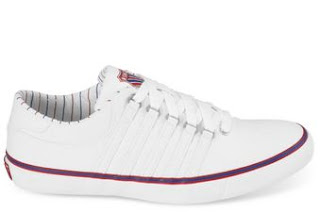
White Tennies


7. A girl & her pearls: I would be remiss to overlook the tradition of the Bostonian socialite and southern belle. A girl must always have a string of gleaming white pearls.
 

Of course, the list is far from complete. Perhaps there is something which you would add?