|
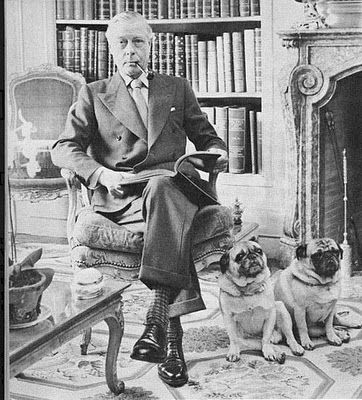
| P.G. Wodehouse via The Guardian |
Today is
P.G. Wodehouse's birthday. The humorist produced 96 books with such ease that he is stilled shunned by some "serious" scholars. The prose, by his own admission, was "light," its humor, ready. Although his novels were rooted in the Anglo culture, customs, and psyche, P.G. Wodehouse spent the majority of his life in America. "I have always been awfully fond of America. It always seemed like my own country. I don’t know why. I’d much sooner live here than in England, I think. I can’t think of any place in England I prefer to this." Below is an excerpt from
Gerald Clarke's interview with the writer as published in
The Paris Review's Winter 1975 issue:
INTERVIEWER: What have you been reading most recently?
WODEHOUSE: I’ve been reading the old books, books that I’ve read before. The first time you read a book, you don’t read it at all carefully; you just read it for the story. You have to keep rereading. Every year or so I read Shakespeare straight through. But then I go to the latest by Agatha Christie or Rex Stout. I read every book of theirs. I do like a book with an elaborate plot. But I haven’t any definite plan of reading. I read almost everything, and I like anything that’s good. I’ve just reread a book of A. A. Milne’s called Two People, which I had read several times before. His novel is simply a novel of character. It’s not the sort of thing I can write myself, but as a reader I enjoy it thoroughly.
INTERVIEWER: Do you read any contemporary novels?
WODEHOUSE: I’ve read some of Norman Mailer.
INTERVIEWER: Do you like his writing?
WODEHOUSE: I don’t like his novels very much, but he writes very interesting nonfiction stuff. I liked Advertisements for Myself very much.
INTERVIEWER: How about the Beats? Someone like Jack Kerouac, for instance, who died a few years ago?
WODEHOUSE: Jack Kerouac died! Did he?
INTERVIEWER: Yes.
WODEHOUSE: Oh . . . Gosh, they do die off, don’t they?
INTERVIEWER: Do you ever go back and reread your own books?
WODEHOUSE: Oh, yes.
INTERVIEWER: Are you ever surprised by them?
WODEHOUSE: I’m rather surprised that they’re so good.
INTERVIEWER: Of all the books you’ve written, do you have any favorites?
WODEHOUSE: Oh, I’m very fond of a book called Quick Service and another called Sam in the Suburbs, a very old one. But I really like them all. There are very few exceptions.
INTERVIEWER: Have you ever been envious of another writer?
WODEHOUSE: No, never. I’m really such a voracious reader that I’m only too grateful to get some stuff I can read.
INTERVIEWER: Have any other writers ever been envious of you?
WODEHOUSE: Well, I always thought A. A. Milne was rather. We were supposed to be quite good friends, but, you know, in a sort of way I think he was a pretty jealous chap. I think he was probably jealous of all other writers. But I loved his stuff. That’s one thing I’m very grateful for: I don’t have to like an awful person to like his stuff. I like Somerset Maugham’s stuff tremendously, for example, but I should think he was unhappy all the time, wouldn’t you? He was an unpleasant man.
INTERVIEWER: Was he unpleasant to you?
WODEHOUSE: No. He was all right to me. We got along on just sort of “how do you do” terms. I remember walking back from a cricket match at Lords in London, and Maugham came along on the other side. He looked at me and I looked at him, and we were thinking the same thing: Oh, my God, shall we have to stop and talk? Fortunately, we didn’t.


 The romantic relationship succeeded in capturing the imagination of America as it struggled to survive the Great Depression. So much so, in fact, that in 1936, America's weekly news magazine, TIME, chose Wallis Simpson to be the first female awarded TIME's "Person of the Year." Edward VIII's relationship with Wallis defied both the wishes of his family and the British government. It soon became clear that Edward could have Wallis or the throne; but he could not have both. Presented with this choice, Edward, under what many felt to be the bewitchment of Wallis' stronger personality, opted for love and left the throne to his younger and quite unprepared brother, George VI (or "Bertie").