
Friday, March 4, 2011
Cliburn Plays Tchaikovsky Piano Concerto No.1
By his 23rd year, Van Cliburn had gained the world's attention. His victory in Moscow at the quadrennial International Tchaikovsky Piano Competition coincided with the crescendo of the Cold War. The subsequent RCA recording of Cliburn playing Tchaikovsky's Piano Concerto No. 1 proved the first classical album to go platinum. It was also my favorite recording as a young girl. Yesterday, President Obama awarded Van Cliburn the National Medal of Arts.

Monday, February 14, 2011

Saturday, February 12, 2011
Pulling out the Red Carpet
 |
| "The Chess Players"/Sir John Lavery |
 |
| "Jeune Femme dans un Interieur"/Léon de Smet |
 |
| "Portrait of Vsevolod Meyerhold"/Pyotr Konchalovsky |
 |
| "The Gallery" (1952)/Leonard Campell Taylor |
 |
| The Coronation of Ladislave of Naples"/Mato Celestin Medović |
 |
| "Girl on a Red Carpet" (1912)/Felice Casorati |
Thursday, January 27, 2011
Protest for Stromness
 |
| Photograph: Murdo Macleod |
Sir Peter Maxwell Davies is an English composer, honored with the position of Master of the Queen's Music. In the late 1970s, Stromness, a village in Scotland, learned that mining companies had received approval to open a uranium mine two miles from the center of their town. The public protest grew as residents feared the pollution would eventually lead to a small apocalypse for Scotland's Orkney Islands.
As part of a fundraiser effort for the protests, Sir Peter Maxwell Davies, a resident, composed and performed Farewell to Stromness. And the cabaret-style piano interlude has continued to inspire musicians. Its bittersweet elegance and "slow, walking bass line...[is meant to portray] the residents of the village of Stromness having to leave their homes as a result of uranium contamination." At the Stromness Hotel, Davies first performed it in June 1980 during the St. Magnus Festival. The uranium mine was eventually canceled and Stromness, despite its small size, still thrives.
Monday, January 24, 2011

Thursday, January 20, 2011
Post-War Scotland
 |
| Boy and Brazier, Gorbals 1968 |
Oscar Marzaroli (1933–1988), an Italian-born photographer whose family immigrated to Scotland when he was a child, captured post-World War II, urban Glasgow with a powerful lens. The Bourne Fine Art Gallery featured his work, especially that of 1958-68, in an exhibition last November. I didn't blog about it at the time, but the photographs wriggled there way into my brain and have implanted themselves permanently it would seem. A sampling of that exhibition can be found here.
 | |
| Flitting Gorbals 1965 |
 |
| Golden Haired Lass |
 |
| Boy and Pram, Gorbals 1964 |
Further, Marzaroli's work has inspired a diverse group of artistic endeavors. Ricky Ross, Scottish singer-songwriter and member of Deacon Blue, has recorded Marzaroli's influence in an audio tribute that includes interviews with Oscar's wife Anne and others with whom Marzaroli was intimate. Among other things, friends and family remember him as "very tall...very charming...cut[ting] quite an exotic figure."
 |
| Fisherman in Boat |
Liz Peden, a teacher at the Global Arts Project, found inspiration in Marzaroli's original photograph "Gorbals Boys 1963." She re-imagines this "iconic photograph" through a three-part sculpture made of chrome and bronze that recreates the three, dusty boys captured playing in their mother's high heels through the streets within Marzaroli's photograph. Her work is also entitled "Gorbals Boys."
 |
| Gorbals Boys 1963 |
 |
| Liz Peden's "Gorbals Boys" |
Wednesday, January 19, 2011
To Catch a Fox
 |
| Time Life/John Dominis |
“I never ride just to ride. I ride to catch a fox.”
R. Sargent Shriver, 1915-2011
Monday, January 17, 2011

Monday, January 3, 2011
Sensible Tea Habits
 |
| George Orwell (illustration found here) |
Eric Arthur Blair (aka George Orwell), like many Englishmen, was a connoisseur of tea. Recently, at Slate, the online news-magazine, Christopher Hitchens recommended Orwell's "A Nice Cup of Tea," a 1946 article that ran in the Evening Standard. While Orwell boasts a list of 11 rules, these "essential [rules] are easily committed to memory," according to Higgins. Several are humorously archaic. Even if you aren't a tea drinker, it's amusing enough.
Here are my own eleven rules, every one of which I regard as golden:
First of all, one should use Indian or Ceylonese tea. China tea has virtues which are not to be despised nowadays — it is economical, and one can drink it without milk — but there is not much stimulation in it. One does not feel wiser, braver or more optimistic after drinking it. Anyone who has used that comforting phrase 'a nice cup of tea' invariably means Indian tea.
Secondly, tea should be made in small quantities — that is, in a teapot. Tea out of an urn is always tasteless, while army tea, made in a cauldron, tastes of grease and whitewash. The teapot should be made of china or earthenware. Silver or Britanniaware teapots produce inferior tea and enamel pots are worse; though curiously enough a pewter teapot (a rarity nowadays) is not so bad.
Thirdly, the pot should be warmed beforehand. This is better done by placing it on the hob than by the usual method of swilling it out with hot water.
Fourthly, the tea should be strong. For a pot holding a quart, if you are going to fill it nearly to the brim, six heaped teaspoons would be about right. In a time of rationing, this is not an idea that can be realized on every day of the week, but I maintain that one strong cup of tea is better than twenty weak ones. All true tea lovers not only like their tea strong, but like it a little stronger with each year that passes — a fact which is recognized in the extra ration issued to old-age pensioners.
Fifthly, the tea should be put straight into the pot. No strainers, muslin bags or other devices to imprison the tea. In some countries teapots are fitted with little dangling baskets under the spout to catch the stray leaves, which are supposed to be harmful. Actually one can swallow tea-leaves in considerable quantities without ill effect, and if the tea is not loose in the pot it never infuses properly.
 |
| found here |
Sixthly, one should take the teapot to the kettle and not the other way about. The water should be actually boiling at the moment of impact, which means that one should keep it on the flame while one pours. Some people add that one should only use water that has been freshly brought to the boil, but I have never noticed that it makes any difference.
Seventhly, after making the tea, one should stir it, or better, give the pot a good shake, afterwards allowing the leaves to settle.
Eighthly, one should drink out of a good breakfast cup — that is, the cylindrical type of cup, not the flat, shallow type. The breakfast cup holds more, and with the other kind one's tea is always half cold before one has well started on it.
 |
| a good breakfast cup |
Ninthly, one should pour the cream off the milk before using it for tea. Milk that is too creamy always gives tea a sickly taste.
Tenthly, one should pour tea into the cup first. This is one of the most controversial points of all; indeed in every family in Britain there are probably two schools of thought on the subject. The milk-first school can bring forward some fairly strong arguments, but I maintain that my own argument is unanswerable. This is that, by putting the tea in first and stirring as one pours, one can exactly regulate the amount of milk whereas one is liable to put in too much milk if one does it the other way round.
Lastly, tea — unless one is drinking it in the Russian style — should be drunk without sugar. I know very well that I am in a minority here. But still, how can you call yourself a true tealover if you destroy the flavour of your tea by putting sugar in it? It would be equally reasonable to put in pepper or salt. Tea is meant to be bitter, just as beer is meant to be bitter. If you sweeten it, you are no longer tasting the tea, you are merely tasting the sugar; you could make a very similar drink by dissolving sugar in plain hot water. Some people would answer that they don't like tea in itself, that they only drink it in order to be warmed and stimulated, and they need sugar to take the taste away. To those misguided people I would say: Try drinking tea without sugar for, say, a fortnight and it is very unlikely that you will ever want to ruin your tea by sweetening it again.
(excerpted from The Collected Essays, Journalism and Letters of George Orwell, Volume 3, 1943-45, Penguin ISBN, 0-14-00-3153-7)
Sunday, January 2, 2011
So Cal Charm
I've just returned from a So Cal holiday. The warm and windy city of Los Angeles exudes that tried-and-true-meets-new vibe. Madeline Stuart's interiors reflect this curious meeting of the mind and eye, specifically in the Bel Air Georgian she designed with Phil DeBolske.


Of course, her other work within Los Angeles similarly emphasizes old world influences on a contemporary life. Here are a few more of my favorites:


Of course, her other work within Los Angeles similarly emphasizes old world influences on a contemporary life. Here are a few more of my favorites:
 |
| Brentwood House |
 |
| Another Bel Air house with a distinct Spanish and Japanese influence |
Sunday, December 12, 2010
The Christmas Photo Card
 |
| via The Telegraph |
Among others, The Telegraph has been poking Charles and Camilla a bit ever since the couple's holiday photo was revealed. This, I confess, is an entirely alien joke to the American. We have come to accept the "jolly stressful [rush]...to find a suitable picture each year." Few "make do with robins or holly or baby Jesus" anymore. After all, what good would a Christmas greeting be if it didn't include a little photographic reminder of who is sending the d-mned card in the first place? Oh, so that's Chuck's new wife...interesting choice.
Saturday, December 11, 2010
Edward VIII
 |
| Edward as Prince of Wales, in Ontario, 1919 |
 The romantic relationship succeeded in capturing the imagination of America as it struggled to survive the Great Depression. So much so, in fact, that in 1936, America's weekly news magazine, TIME, chose Wallis Simpson to be the first female awarded TIME's "Person of the Year." Edward VIII's relationship with Wallis defied both the wishes of his family and the British government. It soon became clear that Edward could have Wallis or the throne; but he could not have both. Presented with this choice, Edward, under what many felt to be the bewitchment of Wallis' stronger personality, opted for love and left the throne to his younger and quite unprepared brother, George VI (or "Bertie").

Living in France, the Duke and Duchess made little effort to avoid accusations of pro-Nazi sympathies. The Duke gave dubious public statements, which left his sympathies up for interpretation. The Duchess was chummy with Diana Mitford, a well-known Nazi sympathizer. With the outbreak of war, PM Winston Churchill threatened the Duke with court-martial in order to persuade him to accept the wartime governorship of the Bahamas, a British colony.
Although the Duke succeeded in doing some good during his governorship, it is difficult to view the Windsors' time in the Bahamas without some distaste. The Duke and Duchess' prejudices were too often vocalized, and the governorship of the Bahamas often showcased the Duke and Duchess' racism. Nevertheless, the British government did succeed in limiting the Duke's damage to the British war effort by preventing him the means or opportunity to act on any pro-fascist sympathies. In his memoir, the Duke defended himself, emphasizing that his admiration for the Germans stopped short of sympathy for fascism.
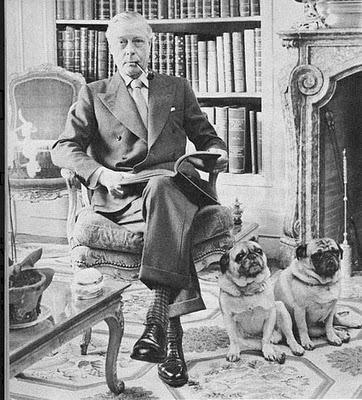 | |
| The Duke in his library as pictured in The Windsor Style by Suzy Menkes |
 | |||
| The Duke & Duchess of Windsor, 1964, via The Windsor Style |
 |
| The Duke of Windsor via The Windsor Style |
Monday, December 6, 2010
A tinkling piano in the next apartment... ♫
 |
Bryan Ferry's airy, eclectic city digsvia WSJ |
These foolish things remind me of you.
A tinkling piano in the next apartment
Those stumblin’ words that told you what my heart meant
A fairground’s painted swings
These foolish things
Remind me of you.
You came,
You saw,
You conquered me
When you did that to me
I knew somehow this had to be
The winds of march that made my heart a dancer
A telephone that rings but who’s to answer
Oh, how the ghost of you clings
These foolish things
Remind me of you
(excerpted from that ol' standard, These Foolish Things, famously covered by Bryan Ferry)
Thursday, November 25, 2010
Thanksigiving
Well, the turkeys are pardoned (Thank you, Mr. President; can I retire to Mount Vernon too?), the pies are made, and freezing rain is washing my front steps. I buzz about in eager anticipation of the much-advertised, self-stereotyping NPR thanksgiving broadcast, featuring warm and fuzzy thoughts from Chopra Deepak and Thanksgiving cooking advice from Nigella Lawson. Clearly, NPR enjoys egging on angst-riddled, middle-class Americans, for whom Thanksgiving holiday is quite problematic.
Gobble, gobble.
Gobble, gobble.
Tuesday, November 23, 2010
Wearing White in America
When it comes to wearing white, Americans adhere to a peculiar code. Of course, this code alters with geography and culture; wearing white in Washington D.C. is very different from wearing white in New York City, Chicago, or Atlanta. And, before you read further, I must confess to not knowing much about the west coast as I've spent most of my life adhering to that one simple, possibly unfair, rule: "Limit your time in California."
1. White Teeth: We like our teeth as white as our paper, or so my German friends tease. You can never have teeth too white or too glossy. Teeth are no occasion for modest, matte tones.
2. Wear white shoes between Easter and Labor Day: This rule firmly continues to make its mark on America. Whether or not you follow the rule speaks volumes about how you view yourself and your place in society. Wearing white shoes is synonymous with vacationing, an activity relegated to those months between Easter and Labor Day for most middle-class families. (This probably explains the reputation American tourists have for tromping about Europe in gleaming white tennies.)
3. Bright vs. weathered white clothing: Although there are exceptions, Americans, as a general rule, do not wear bleached, bright whites in urban or country settings but rather at the beach. Our whites tend to be weathered or "dirty" to an outsider's eye, so our whites are not pure white, per say, but off-white, ivory, winter white, or "natural" white. The one consistent exception to this is a professional one, wherein some business, medical, or political occupations beg for a crisp white collar as a part of the daily uniform.
4. One of many exceptions is White Linen Night: Every sultry summer, southerners (particularly those in Houston and New Orleans) don their white linen and stroll around the arts districts for an evening of cultural leisure. For some reason, this habit, as well as its cousin--Dirty Linen Night--which falls in step with the American tradition of mussed whites, has a way of popping up at any Southern art festival.
6. White Bucks v. White Tennies: These two staples of the American wardrobe probably represent the range of American dress better than anything else. The bucks fall into that mussed white category while the tennis shoes fall into the gleaming white category.
7. A girl & her pearls: I would be remiss to overlook the tradition of the Bostonian socialite and southern belle. A girl must always have a string of gleaming white pearls.
Of course, the list is far from complete. Perhaps there is something which you would add?
 |
| The Hollywood Smile |
1. White Teeth: We like our teeth as white as our paper, or so my German friends tease. You can never have teeth too white or too glossy. Teeth are no occasion for modest, matte tones.
2. Wear white shoes between Easter and Labor Day: This rule firmly continues to make its mark on America. Whether or not you follow the rule speaks volumes about how you view yourself and your place in society. Wearing white shoes is synonymous with vacationing, an activity relegated to those months between Easter and Labor Day for most middle-class families. (This probably explains the reputation American tourists have for tromping about Europe in gleaming white tennies.)
 |
| Summer 2009 collection |
 | |||||||||||||
| Whitney White Linen Night (captured by Kevin Zansler) |
4. One of many exceptions is White Linen Night: Every sultry summer, southerners (particularly those in Houston and New Orleans) don their white linen and stroll around the arts districts for an evening of cultural leisure. For some reason, this habit, as well as its cousin--Dirty Linen Night--which falls in step with the American tradition of mussed whites, has a way of popping up at any Southern art festival.
 |
| White Bucks |
6. White Bucks v. White Tennies: These two staples of the American wardrobe probably represent the range of American dress better than anything else. The bucks fall into that mussed white category while the tennis shoes fall into the gleaming white category.
 |
| White Tennies |
7. A girl & her pearls: I would be remiss to overlook the tradition of the Bostonian socialite and southern belle. A girl must always have a string of gleaming white pearls.
Of course, the list is far from complete. Perhaps there is something which you would add?
Dressed to the Kilt
 |
| The Oft-kilted Sean Connery Photo: Source Unknown Well, the word has made it all the way to the Washington Post: The Scottish Tartans Authority wants to put and end to the "childish and unhygienic" habit of going commando beneath one's kilt. Really. Yes, it was an official announcement. Parentalism is alive and well... |
Wednesday, November 17, 2010
Queen Elizabeth I
 |
| 'The Ermine Portrait' of Elizabeth I, c1585, by Nicholas Hilliard |
On November 17, 1558, Elizabeth I acceded to the English throne. Edmund Spenser famously wrote of Elizabeth in The Faerie Queene. In his work, he names the queen Gloriana.
When Elizabeth I heard the news of her accession that November, she allegedly quoted the twenty-third line of Psalm 118 in Latin: A Dominum factum est illud, et est mirabile in oculis notris. ("It is the Lord's doing, and it is marvelous in our eyes.")Sunne of the world, great glory of the sky,That all the earth doest lighten with thy rayes,Great Gloriana, greatest majesty!
Tuesday, November 16, 2010

Another American Dream
Americans love a house. It's indispensable to the American dream. Of course, the houses in America are only, at the most, several hundred years old. Thus, Americans are quick to hire a decorator--arguably an American invention in itself--to make their new houses feel modern, "lived-in," fresh, or ancestral (to each his own) as soon (or often) as possible.
Making the client's house feel worn and familiar strikes me as one of the American designer's more difficult tasks. The Badgley Mischka duo's Kentucky 1920s limestone-and-clapboard Dutch Colonial Revival qualifies, I think, as an "oldie but a goodie" in this regard. (The internet age has lowered the standards even further for admission to the American "oldie" category.) What's more? They are talented enough to decorate and develop the property themselves.


Making the client's house feel worn and familiar strikes me as one of the American designer's more difficult tasks. The Badgley Mischka duo's Kentucky 1920s limestone-and-clapboard Dutch Colonial Revival qualifies, I think, as an "oldie but a goodie" in this regard. (The internet age has lowered the standards even further for admission to the American "oldie" category.) What's more? They are talented enough to decorate and develop the property themselves.

 |
 |
 |

Photos taken by Roger Davies for Elle Decor
Thursday, November 11, 2010
At War
 | ||
| Wilfrid Wilson Gibson (1878-1962) |
My first concept of modern war was, after all, shaped by "Breakfast," his ironic war poem:
We ate our breakfast lying on our backs,Later, in secondary school, I became fascinated with those Gibson poems paying tribute to the houses he would chance upon (I'm American, after all; so I love a house). Two of Gibson's references to houses I named favorites because of their juxtaposition in my mind. The first was "Tenants," a poem which reminded me of a cottage we would visit as a family each summer:
Because the shells were screeching overhead.
I bet a rasher to a loaf of bread
That Hull United would beat Halifax
When Jimmy Strainthorpe played full-back instead
Of Billy Bradford. Ginger raised his head
And cursed, and took the bet; and dropped back dead.
We ate our breakfast lying on our backs,
Because the shells were screeching overhead.
Suddenly, out of dark and leafy ways,The second, "Reveille," recalled those first impressions that Gibson's war poetry made on me in elementary school:
We came upon the little house asleep
In cold blind stillness, shadowless and deep,
In the white magic of the full moon-blaze.
Strangers without the gate, we stood agaze,
Fearful to break that quiet, and to creep
Into the home that had been ours to keep
Through a long year of happy nights and days.
So unfamiliar in the white moon-gleam,
So old and ghostly like a house of dream
It seemed, that over us there stole the dread
That even as we watched it, side, by side,
The ghosts of lovers, who had lived and died
Within its walls, were sleeping in our bed.
Still bathed in its moonlight slumber, the little white house by the cedar
Stands silent against the red dawn;
And nothing I know of who sleeps there, to the travail of day yet unwakened,
Behind the blue curtains undrawn:
But I dream as we march down the roadway, ringing loud and white-rimmed in the moonlight,
Of a little dark house on a hill
Wherein when the battle is over, to the rapture of day yet unwakened,
We shall slumber as dreamless and still.
Subscribe to:
Posts (Atom)